
INVISIBLE POWER OF NETWORKS
HOW DIGITAL MEDIA SHAPES PUBLIC OPINION
DOI:
https://doi.org/10.32813/2179-1120.2025.v18.n2.a1203Keywords:
Fake News, , Political Polarization, Democratic Health, Public OpinionAbstract
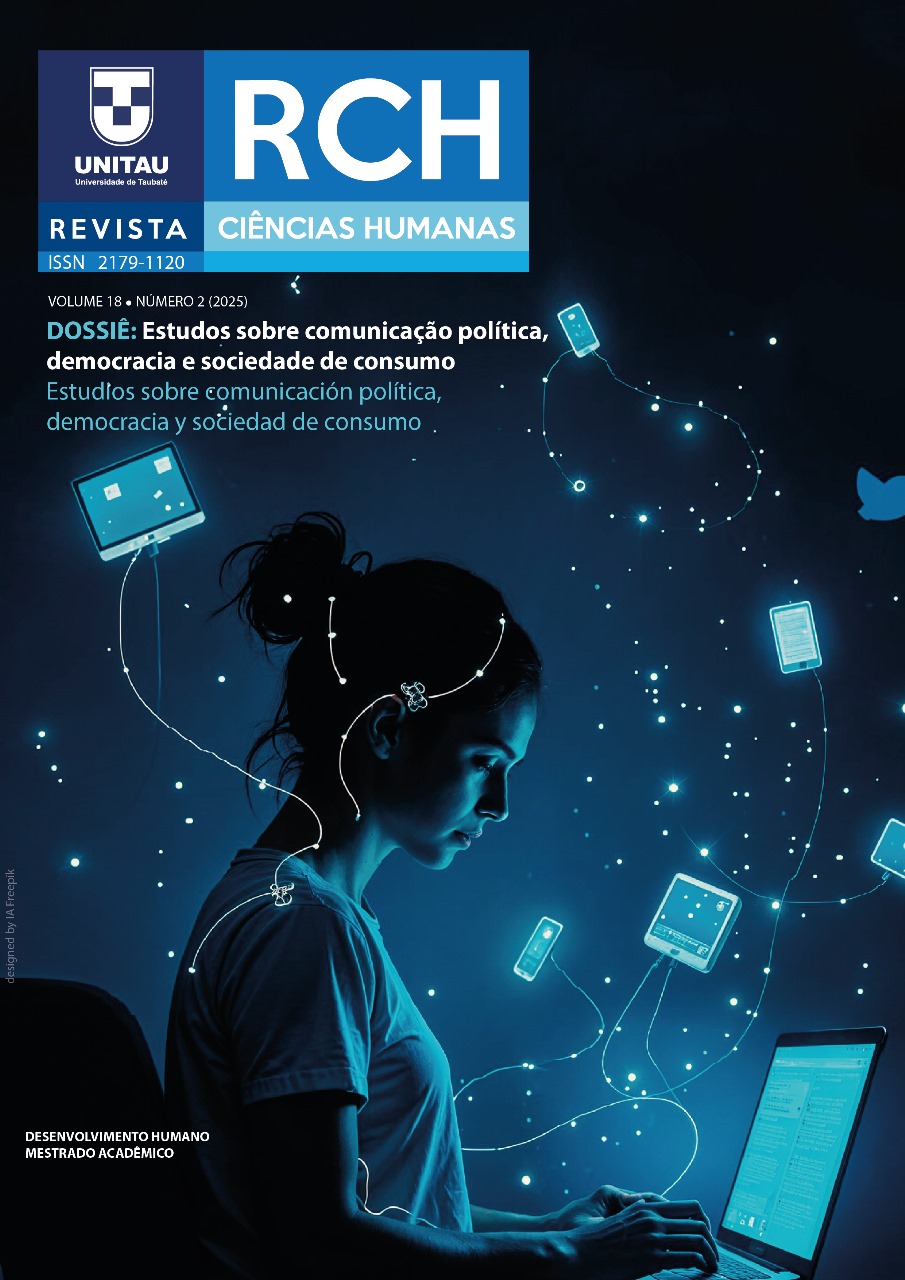
This study analyzes the effect of digital media, especially social networks, on the formation of public opinion and its effects on democratic health. The objective is to analyze the role of these media in the formation of public opinion in contemporary society, investigating their effects on democratic health. The aim is to understand how the dissemination of fake news and the manipulation of information affect the electoral process and trust in democratic institutions. The research starts from the following central question: in what way do digital media, by amplifying the dissemination of fake news and manipulating the formation of public opinion, contribute to the increase in political polarization and weaken democracy? The methodology adopted is a qualitative literature review. The main results demonstrate that digital media directly influence political polarization, driven by algorithms that reinforce preferences and increase the circulation of misinformation. Social networks function as fertile spaces for the propagation of manipulated content, hindering democratic dialogue and promoting distrust in institutions. The formation of information bubbles is also observed, which restrict contact with divergent views and accentuate political fragmentation. Although they expand access to information, these media pose real risks to democratic health and public debate.
Metrics
References
ADORNO, Theodor W. A personalidade autoritária. Lisboa: Antígona, 1982.
ADORNO, Theodor; HORKHEIMER, Max. A indústria cultural: o esclarecimento como mistificação das massas. Rio de Janeiro: Jorge Zahar, 2002.
ARENDT, Hannah. Origens do totalitarismo. São Paulo: Companhia das Letras, 2009.
DURKHEIM, Émile. O suicídio: estudo de sociologia. São Paulo: Martins Fontes, 1999.
BENKLER, Yochai. A riqueza das redes: como a produção social transforma mercados e liberdade. Rio de Janeiro: Elsevier, 2006.
BOURDIEU, Pierre. A opinião pública não existe. In: ENCREVÉ, Pierre; LORTIE, Rose-Marie (Org.). Problemas na sociologia. Petrópolis: Vozes, 1983.
BRAGA, F. L. A concentração da mídia no Brasil e suas implicações políticas. Rio de Janeiro: Editora FGV, 2019.
BROWN, Wendy. Nas ruínas do neoliberalismo: a ascensão da política antidemocrática no Ocidente. São Paulo: Editora Politeia, 2019.
CASTELLS, Manuel. A sociedade em rede. 9. ed. São Paulo: Paz e Terra, 2009.
______. Redes de indignação e esperança: movimentos sociais na era da internet. Rio de Janeiro: Zahar, 2013.
CASTRO, D. R. de. A influência das fake news nas eleições brasileiras de 2018: O impacto das redes sociais na formação da opinião pública. São Paulo: Editora da Universidade, 2019.
CHOMSKY, Noam. Fabricando consentimento: A economia política da mídia de massa. São Paulo: Outras Expressões, 1997.
ELIAS, Norbert. O processo civilizador: uma história dos costumes. Rio de Janeiro: Jorge Zahar, 1994.
HABERMAS, Jürgen. Mudança estrutural da esfera pública: Investigação sobre uma categoria da sociedade burguesa. Tradução de Maria Lúcia Pallares-Burke. 3. ed. Rio de Janeiro: Tempo Brasileiro, 1997.
LACLAU, Ernesto; MOUFFE, Chantal. Hegemonia e estratégia socialista: Para uma radicalização da democracia. Rio de Janeiro: Vozes, 2001.
LEVITSKY, Steven; ZIBLATT, Daniel. Como as democracias morrem. São Paulo: Zahar, 2018.
MACHADO, R. M. Concentração midiática e democracia: os desafios do pluralismo informativo. São Paulo: Editora Unesp, 2017.
MANNHEIM, Karl. Ideologia e utopia: Introdução à sociologia do conhecimento. Tradução de Paulo Neves. Rio de Janeiro: Zahar, 1982.
McLUHAN, Marshall. Os meios de comunicação como extensões do homem. São Paulo: Cultrix, 1964.
PARKER, C.; KESSLER, S.; SANDERS, A. A ascensão das fake news e seus efeitos na opinião pública. Journal of Political Communication, v. 34, n. 2, p. 115-130, 2019. Disponível em: https://www.tandfonline.com/doi/full/10.1080/10584609.2019.1596036.
Acesso em: jan. 2025.
POSTMAN, Neil. Divertindo-nos até a morte: a sociedade do espetáculo. São Paulo: Artmed, 1985.
TOCQUEVILLE, Alexis de. A democracia na América. Tradução de Sérgio Lessa. 1. ed. Rio de Janeiro: Editora UnB, 2001.
Downloads
Published
How to Cite
Issue
Section
License
Copyright (c) 2025 Human Sciences Journal - RCH

This work is licensed under a Creative Commons Attribution 4.0 International License.
The publications of the Human Sciences Journal are registered under the Creative Commons Attribution CC-BY license.
1. The contents of the manuscripts are the exclusive responsibility of their author.
2. It is allowed the total or partial reproduction of manuscripts published in the journal, provided that the source is cited.
3. When submitting their manuscript to the Journal, the authors certify that they are of their own authorship and unpublished (not published in any digital or printed media).
4. The copyright of the articles published in the Journal are of the author, with first publication rights reserved for this journal.
5. For disclosure purposes, the Journal may replicate the works published in this journal in other media, such as social networks (Facebook, Academia.Edu, etc.).
6. The Journal is of public access, therefore, the authors who submit manuscripts agree that they are of free use.
7. In case of any illegality, fraud, or other attitude that puts in doubt the honesty of the publication, especially the practice of plagiarism, the manuscript will be automatically rejected.
8. If the manuscript has already been published, it will be immediately removed from the base of the Journal, its citation linked to the Journal will be prohibited and the cancellation of the referred publication shall be reported in the next issue of the one in which the article was published. In case of the procedure for the withdrawal of the paper the authors will be informed beforehand, being guaranteed the right to a broad defense.
9. The personal data provided by the authors will be used exclusively for the services provided by this publication and will not be made available for other purposes or to third parties.
 Português (Brasil)
 English
 Español (España)